Lat Pulldown

Activation
Muscles worked
Movement
Vertical Pull
Beginner · Selectorized Strength
Primary muscles
Movement pattern
Equipment category
How to perform
- 1
Set up
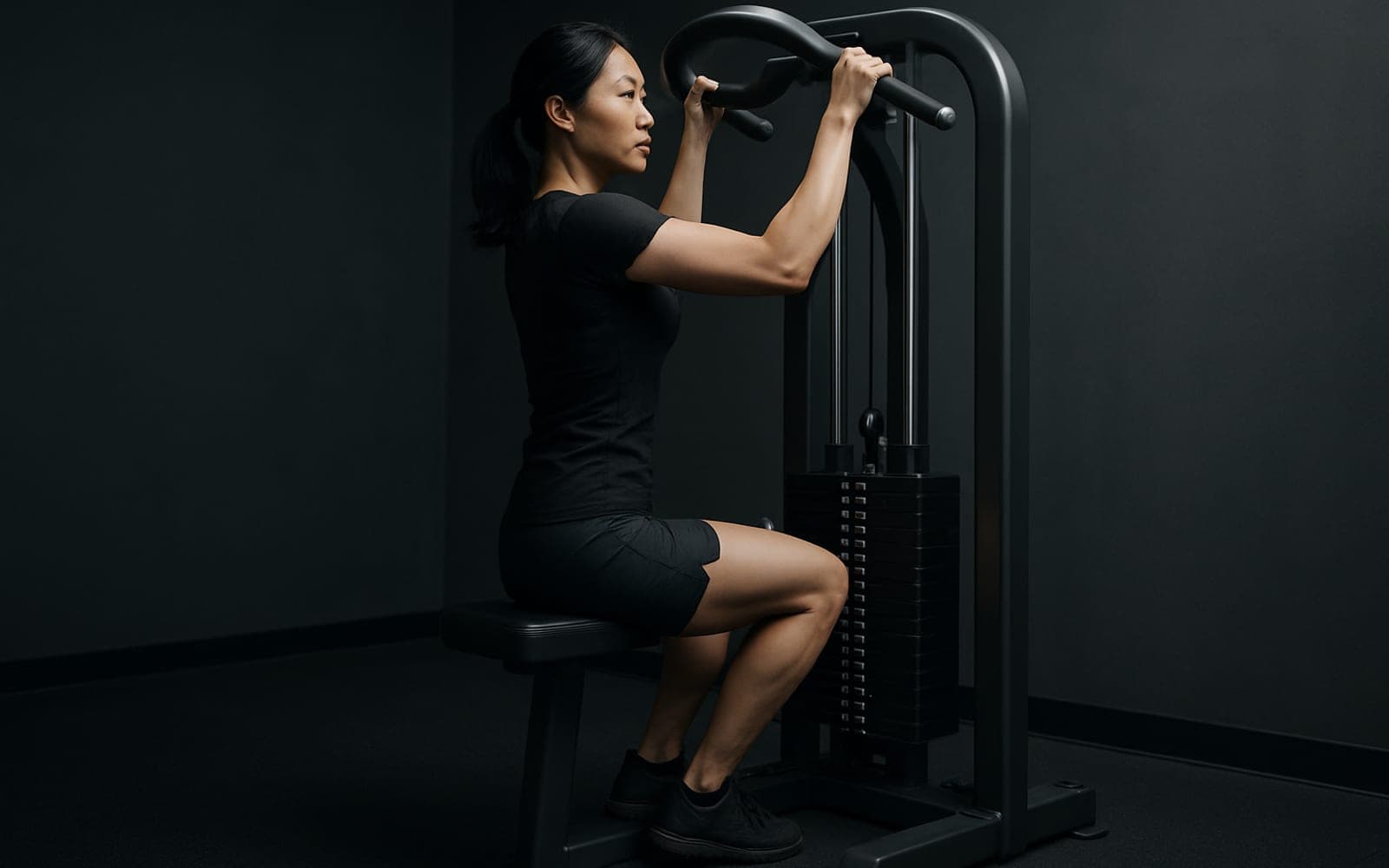
Set the thigh pad snug; grip slightly wider than shoulders.
- 2
Execute the movement
Pull the bar to the upper chest by driving the elbows down; control the return.
Common mistakes
- Leaning way back
- Pulling behind the neck
Make it harder
Make it easier
Accessibility
Substitutions
If a machine is busy or unavailable, these train the same pattern a different way.


Your progress over time
What to expect from training this consistently — everyone progresses at their own pace.
- 1
First few sessions
Learn movement pattern and breathing: establish scapular depression/retraction, feel lats engage when pulling the bar to the upper chest, and practice controlled eccentric returns with light weight.
- 2
Weeks 2–6
Build neuromuscular control and work capacity: increase confidence with heavier sets, move from very light to moderate loads for 8–15 reps, and notice reduced reliance on the arms as the lats become more active.
- 3
Months 2–4
Measurable strength and size gains: progressively overload with heavier weights or added volume, see visible mid-back and lat development, and improve 1–3 RM strength on heavier sets.
- 4
Months 4–8
Consistent performance improvements: further increases in load and control, ability to use variations (close/wide grip) effectively, and clearer carryover to bodyweight vertical pulling progressions.
- 5
6+ months
Long-term capacity and maintenance: maintain higher absolute pulling strength and back thickness, manage plateaus with programmed variation, and use the movement as a reliable tool for general fitness and posture support.
Benefits of the lat pulldown
Primary stimulus for the latissimus dorsi, promoting width and strength of the upper back when performed with proper elbow-driven pulling.
Develops vertical pulling strength that transfers to pull-ups and other overhead pulling activities.
Provides secondary loading for the biceps and mid-back musculature, improving arm strength and scapular stability.
Enhances posture by reinforcing scapular retraction and thoracic control, helping counteract forward-shoulder positions common with desk work.
Scalable and accessible for beginners while remaining useful for advanced trainees, making it an effective tool for progressive overload and general fitness.
Low-skill entry point to train pulling mechanics with controlled eccentrics, reducing joint stress compared with some free-weight alternatives when performed correctly.
Exercises that pair with this
Same muscles or the same movement pattern — useful for building the rest of the session.






Lat Pulldown — questions people ask
What muscles does the lat pulldown work?
The lat pulldown trains the lats as the primary target, with the biceps, mid-back working as support. It is a vertical pull pattern, so it also trains the coordination that pattern needs.
How many sets and reps of the lat pulldown should I do?
For size, three to four sets of 8–12 reps with 60–90 seconds of rest. For strength, three to five sets of 3–6 reps with longer rest. Add a little weight once you hit the top of the range on every set.
Is the lat pulldown good for beginners?
Yes. The lat pulldown is a beginner-friendly movement. Reduce weight. If it feels like too much, build the pattern on the assisted pull-up first.
What can I do instead of the lat pulldown?
Seated Cable Row, Assisted Pull-Up, Band Pulldown all train the same vertical pull pattern with different equipment, so any of them works when the machine is busy or your gym does not have it.
What are the most common lat pulldown mistakes?
Leaning way back; Pulling behind the neck. Pull the bar to the upper chest by driving the elbows down; control the return.
Can I do the lat pulldown at home?
The lat pulldown needs selectorized strength equipment, which most home gyms do not have. The assisted pull-up trains the same pattern with nothing more than your bodyweight or a band.